Before anything else please do me a big,
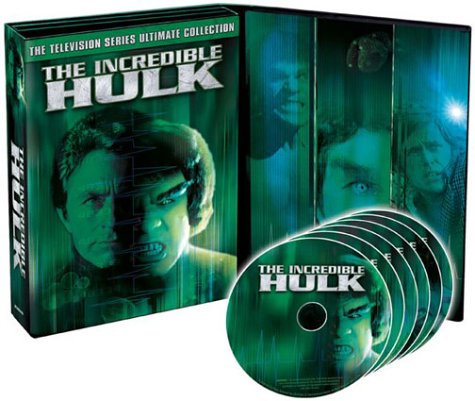
BIG favor if you’re either a casual fan or new viewer to the live-action, Network TV version of "The Incredible Hulk" and have any intention of purchasing/renting this "Ultimate Collection" Universal Studios Box Set. Instead of following the 1-6 numerology in which these discs & episodes have been arranged by Universal’s clueless DVD powers-that-be, please watch the discs in the following order. Trust me, mmkay? The dramatic revelations, recurring drama and building tension that comes from watching these shows in their proper broadcast/plot order is more than worth the inconvenience of re-arranging the disc order.
-Disc 2, ‘The Race Against Time.’
-Disc 1, ‘The Search for a Cure.’
-Disc 4, ‘The Files of Jack McGee.’
-Disc 5, ‘The Beast Within.’
-Disc 3, ‘The Legend of The Incredible Hulk.’
-Disc 6, ‘The Hidden Powers of The Incredible Hulk.’
Got that? Good. As a child of the 1970’s that absolutely, positively hates reading/listening/watching other people idolize terrible songs/TV shows/movies/books with the candy-colored eyesight of nostalgia, I’m faced with the dilemma of reviewing yet again a TV show that has been near and dear to my heart since I watched it as a young child (in Spanish!) back in the late 1970’s/early 1980’s. My love and affection for Kenneth Johnson’s Network TV adaptation of Stan Lee’s comic book superhero (which has also appeared on Saturday Morning TV cartoons as well as this year’s blockbuster "Hulk" summer movie) has been well-documented in a couple of previous DVD releases that can be found under this website’s ‘H’ DVD section. But I believe I’m also a mature and old-enough man (30 going on 31) to be able to watch movies, play games, read books and analyze TV programs with as dispassionate and detached a perspective as the situation demands. I’m not a regular viewer of "The Simpsons," for example, and yet I gave all three DVD Box Sets of the Fox-TV animated series high ratings based on their respective merits.
As my recent reviews of "Battlestar Galactica," "Tomb Raider: Angel of Darkness" and "The Matrix Reloaded" have hopefully proven, hype and nostalgia take a backseat to the practicality of the here and now when it comes to giving the lowdown on whether something is worth your hard-earned dough in today’s interactive entertainment market. Yet my facade of impartiality crumbles like a house of cards when I watched David Banner (Bill Bixby in the acting role that would come to define him) sob uncontrollably toward the end of the second half of ‘The First’ (Disc 3) before the justifiable transformation into his green-muscled alter ego (bodybuilding legend Lou Ferrigno) while National Register reporter Jack McGee (Jack Colvin) raced toward the scene. It’s a moment so alive and super-charged with sincerity, pathos, sadness and emotion (not manufactured-for-the-sake-of-a-scene emotion, but the type of deeply felt and sincere emotion that makes grown-up viewers cry alongside the lead character) that a photoplay like Ang Lee’s "Hulk" movie can only dream of ever achieving such glorious heights of dramatic sincerity.
More than any other science fiction property in the past few decades, "The Incredible Hulk" never loses sight of the human emotions that fuel the best (and most memorable) hour-long dramas and Shakespearean tragedies. Any true fan of this show, for example, knows that David Banner refers to his uncontrollable alter ego as ‘the creature’ instead of ‘Hulk’ (even though Jack McGee always uses the latter name for his newspaper headlines). Comic book geeks, however, can’t help but refer to Banner’s states of anger as ‘Hulk-outs.’ So why should we? :-) Universal has compiled 18 hour-long episodes that were deemed by "Hulk" fans as the best from the 85+ shows the TV series racked up over its five seasons on CBS-TV from 1977-1982 into this bare-bones DVD Box Set. Though a few really good episodes didn’t make the cut (‘Proof Positive,’ ‘An Interview with The Hulk,’ ‘Brain Child,’ ‘Equinox,’ ‘Homecoming,’ etc.) there really isn’t a dog in the bunch, only inferior one’s (‘Deep Shock,’ ‘The Disciple,’ etc.) that pale compared to the stellar two-part installments that were the bread and butter of "The Incredible Hulk" during its heyday. Come along for a blow-by-blow account of how well (or not) these 18 shows hold in 2003 in the order in which the discs are actually numbered. Remember though: watch disc 2 first, followed by discs 1, 4, 5, 3 and 6.
DISC 1 - THE SEARCH FOR A CURE
‘Rainbow’s End’ (Aired 10/13/78): Native-American horse trainer Thomas Logan (Ned Romero) has a natural plant formula (inherited from his Indian ancestors) that makes the sports news round when it calms the aggressive behavior of Rainbow’s End, a racing horse with enormous Triple Crown prospects. Banner travels to the next racing track Rainbow’s End is scheduled to race on and volunteers to help Logan, hoping the trainer might use him as a human guinea pig for the horses’ anti-aggression antidote. A barn fire transforms David into the Hulk creature when the former attempts to save Rainbow End; Banner’s change back into human form is witnessed by Logan, who then tries to cure David with a modified version of his natural formula. The father-daughter conflict between two of Rainbow’s End trainers and a crowd of excited horse racing spectators (probably the same gang that stumped all over Banner during the concert scenes of Season Three opener ‘Metamorphosis’), unfortunately, put an early end to David’s aspirations of normalcy.
‘Another Path’ & ‘The Disciple’ (Aired 10/27/78 & 03/16/79):: the 1970’s were the golden age of media-inspired spiritual and martial arts mumbo jumbo: Bruce Lee’s movies, David Carradine’s "Kung Fu" TV series, Saturday afternoon Kung Fu movies on local TV, etc. "The Incredible Hulk" capitalized on this trend with the only two-part installments that (a) didn’t run back-to-back and in which Banner (a) actually returns back to meet a friend he made during a previous adventure. If I were David I would have returned to see if the genius girl from ‘Bran Child’ had come up with some new Gamma Ray theories, but whatever! ‘Another Path’ brings David together with a blind Chinese martial arts philosopher/teacher, Li Sung (Mako), who says he can teach the reluctant scientist meditation techniques that might be able to control Banner’s violent side. The indoctrination ends abruptly when both David and Li Sung are caught in a struggle for control of the latter’s San Francisco-based martial arts school.
‘The Disciple,’ which followed five months after ‘Another Path’ originally aired, was rumored to be a disguised pilot for a proposed TV series about martial arts-handy cop Michael Roark (rock star Rick Springfield) and his blowhard cop brother Colin ("Major Dad’s" Gerald McRaney) that never materialized. The wrap-up ending, where Michael tells Banner he’ll use his martial skills in his new Private Eye career, certainly seems to position the characters for their own spin-off show. Most "Hulk" episodes that momentarily abandoned David’s plight and dealt with the tribulations of guest characters usually sucked (‘Jake,’ ‘Veteran,’ etc.), but ‘The Disciple’ bucks this trend. The scene where Michael Roark (heir-apparent to Li Sung’s leadership position) watches David return to human form after yet another unfortunate ‘Hulk-out’ is touching. So is Li Sung’s next-to-last scene reminiscing to David about how his mentor treated him when he was a young disciple. Though several guest actors returned throughout "The Incredible Hulk’s" run as different characters (the aforementioned Gerald McRaney, Laurie Pringe, Whit Bissell, etc.) Mako’s Li Sung is the only major recurring character to have appeared on more than two "Hulk" shows besides the holy trilogy of Banner (Bixby), McGee (Colvin) and The Hulk (Ferrigno).
DISC 2 - THE RACE AGAINST TIME
‘747’ (Aired 04/07/78): Banner, who has obviously been saving his traveling money from all those hitchhiking rides, gets on a Denver-bound airplane hoping to enter an experimental treatment that might cure his illness. Unfortunately one of the co-pilots and his reluctant stewardess girlfriend plan to drug the crew and jump away in parachutes with valuable Egyptian artifacts worth a fortune, leaving the plane’s passengers to fend for themselves. David somehow gets mixed-up into the mess when the drugged up coffee meant for the plane’s Captain is accidentally ingested by a fellow passenger. After surviving an assassination attempt inside a cargo box in the plane’s below-deck section (!) Banner and a teenage boy obsessed with airplanes (Brandon Cruz, Bill Bixby’s co-star in his "Courtship of Eddy’s Father" 1960’s sitcom) eventually emerge as the only two passengers willing and able to land the 747 safely.
A typical Season One "Hulk" episode (the footage of the 747 plane is lifted directly from Universal’s "Airport 1975"), "747’s" only redeeming qualities are the aforementioned Cruz-Bixby reunion and the scenes in which a stressed-out Banner holds his eventual metamorphosis into the creature for what seems like an eternity while piloting the plane. This ability of Dr. Banner to delay his transformation by using every ounce of his will was often explored in the "Hulk" newspaper comic strip I used to read as kid. "747," sadly, is the only episode of the live-action TV series in which this concept is actually shown and then completely abandoned.
‘Death in the Family’ (Aired 11/28/77):: the second "Hulk" made-for-TV movie after Kenneth Johnson’s far-superior ‘Pilot’ movie that preceded it, ‘Death in the Family’ shows the side of the TV show hardcore fans cringe at: the ‘David Banner just happens to stumble upon the problems of sympathetic characters in far worse situations than his own and which his ‘Hulk’ alter ego ends up correcting’ plot machine working full-tilt. A generic, predictable, often-hooey and by-the-numbers thriller in which David stumbles upon a plan by wicked stepmother Margaret Griffith (Dorothy Tristan) and bought-and-paid-for Dr. Bonifant (William Daniels) to poison his crippled stepdaughter Julie (Laurie Pringe) to inherit the latter’s fortune, this is David Banner at his most histrionic and over-the-top character wise. There is no difference Bixby’s then-green interpretation of the Banner character and an annoyingly concerned Jewish mother. The scenes with Ferrigno’s Hulk character (also learning to give his impressive physique the appropriate body language) don’t fare much better either. The moment in the second half of ‘Death...’ where Banner’s green monster slugs out with a bear (!) in the middle of a swamp has got to rank as one of (if not THE) lowest points of the entire series.
DISC 3 - THE LEGEND OF THE INCREDIBLE HULK
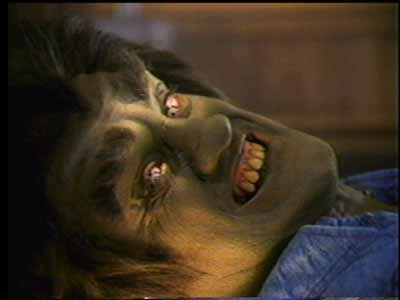
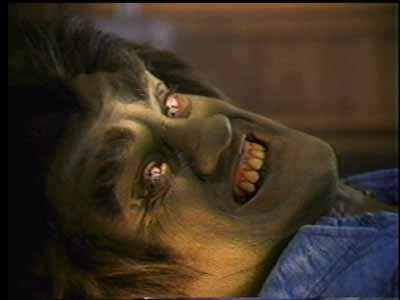
‘The First’ & ‘The First Part II’ (Aired 03/06/81 & 03/13/81): NOW WE’RE TALKING! "Incredible Hulk" story editor Andrew Schneider (who would go on to work with Kenneth Johnson on their TV adaptation of Fox’s "Alien Nation" movie) and director Frank Orsatti successfully brought together the believability of the live-action TV show with the uber-fantastic comic book premise of another "Hulk"-like creature going toe-to-toe with our beloved green giant. The prelude to the actual episode alone is killer (no pun intended), effectively setting the mood for the twisted fantasy that follows. A teenager breaks into the abandoned laboratory of long-deceased mad scientist Dr. Clive in a small middle-of-nowhere American town, and then dies an unspeakable (off-screen) death. Cut to recycled footage of ‘Homecoming’ implying that David arrives at the same town a year after the teen’s death. :-) It turns out there might have been a man afflicted with Banner’s conditions living as early as the 1950’s (instead of the thousands of years implied by the prehistoric Hulk in ‘Kindred Spirits’), one that might have been created (and cured!) by the aforementioned Dr. Clive. David receives unexpected help from a local caretaker, Dell Frye (Harry Townes), that turns out to be the man that turned into a Hulk-like creature before he got cured! Things take a turn for the worse for Banner and everyone else in town (including Billy Green Bush’s Sheriff Carl Decker) when Mr. Frye decides to use Banner’s cure formula to turn into a Hulk-like creature that has already proven his murderous tendencies before (once as a monster and a second time as the selfish Dell Frye).
Even non-fans of the show remember this particular episode; ask anyone that was a child of the 70’s about the ‘Evil Hulk’ and you’ll get lots of positive nods about ‘that skinny Hulk that looked like Jay Leno.’ What could have ended up as a retarded precursor to the "Incredible Hulk Returns" and "Trial" made-for-TV movies of the 1980’s ends up as a gripping drama fraught with a palpable sense of anticipation at not knowing what could happen from one moment to the next. Unpredictability during "Incredible Hulk" episodes that have conditioned their audiences into expecting Banner ‘Hulk-outs’ at 25 and 52 min. intervals during every hour? You better believe it. Will arthritic, bitter old Dell Frye actually kill someone when he willingly allows himself to be beaten up by town bullies in order to unleash his own monstrous alter ego ("Swamp Thing’s" Dick Durock)? Will David be able to use his newfound cure (a bonafide, guaranteed-to-work cure!) on himself before Dell Frye completely loses his marbles? Will Dell Frye’s life-long love interest (played with uncharacteristic high-brow dignity by Lola Albright) help David when he suspects he is also suffering from the same affliction that once overcame Dell Frye in his youth?
Joe Harnell’s appropriately-histrionic music score and Frank Orsatti’s no-nonsense direction add to the frantic mood as ‘The First’ reaches a heart-pounding finale in which two Hulk creatures (one good, the other a proven killer) pound the crap out of each other. The real emotional climax of the episode (and of the entire series IMHO) actually precedes the two Hulk beasts’ battle royale though. The aforementioned scene of David Banner crying his shattered self into a ‘Hulk-out’ at the sight of his much sought-after cure disappearing before his very eyes is the dramatic culmination of every accumulated disappointment and frustrated cure attempt that Banner unsuccessfully tried in all the episodes that preceded this Season Four two-parter (‘Earthquakes Happen,’ ‘The Lottery,’ etc.). I dare you... no, I double-dare you... no, I FUCKING QUINTUPLE-DARE YOU TO FIND A SPLIT-SECOND OF ANG LEE’s "HULK" MOVIE THAT EVEN COMES CLOSE TO REACHING THIS PARTICULAR SCENE’S DEVASTATING POWER PUNCH OF EMOTIONAL ATTACHMENT BY THE AUDIENCE TO ITS LEAD CHARACTER’S PLIGHT. This, my friends, is what elevates and separates classic science fiction drama from wannabe pretenders.
‘Kindred Spirits’ (Aired 04/06/79):: it’s hard to follow the unbeatable Season Four two-part ‘The First’ installments with a Season Two yawner about a prehistoric Hulk-like man-creature that might have existed in the dawn of modern man’s evolution. A museum expedition led by an old archeologist (veteran movie actor Whit Bissell) and his female assistant ("Sex and the City’s" Kim Cattrall as a hottie brunette) might just be on the verge of exhuming the remains of such a fantastic being. David, who is recognized by Cattrall’s Gabrielle White(Cloud) archeologist as her supposedly-deceased Dr. Banner mentor, not only helps him get into the excavation crew but also actively helps Banner search for a potential cure for his metamorphosis dilemma when the scientist tells Gabrielle of his problem. Unfortunately the museum’s excavation crew becomes entangled in a battle between the old Indian guard (represented by Chief Dan George, of "Outlaw Josey Wales" Western fame) and a new impetuous one that wants to use force to drive the white men (including Gabrielle, who chooses to keep her Native American heritage a secret) out of their land.
There are many problems with this "Hulk" episode, not the least of which is the producers’ expectation that the audience will buy that Gabrielle believes David when he tells her (via voice-over narration heard over flashbacks to footage from the ‘Pilot’ episode) that he turns into the same monster they’re trying to dig from beneath its archeological resting ground. No close-ups or reaction shots are ever shown of Kim Cattrall saying ‘no way’ or ‘prove it’ to David when he tells her his unbelievable tale (not that the pretty-but-expressionless-at-the-time young actress could have pulled them off). Then there are the scenes of Lou Ferrigno looking like a poorly-dressed extra in the ‘Flintstones’ movies Universal released in the 1990’s. It’s laughable! It says something about the commitment of the actors and crew members of the show to their craft that, despite these potentially-devastating knocks against it, ‘Kindred Spirits’ actually manages to bring forth some good points about Native Americans dissatisfaction with the way their culture is ripped away from their homelands and placed for exhibition at so-called civilized (read: white) centers of cultural learning. You know, museums.
DISC 4 - THE JACK McGEE FILES
‘Stop the Presses’ (Aired 11/24/78): I have only one question for the powers-that-be at Universal that chose this particular "Hulk" episode as part of a disc entitled ‘The Jack McGee Files’: are you freaking morons?? The Season Three episode ‘Proof Positive,’ which dealt exclusively with how McGee’s obsession with tracking down the creature affected his personal and work-related relationships, was tailor-made for inclusion here. Instead we get a light-hearted and empty chestnut in which David has to infiltrate the National Register headquarters (McGee’s base of operations) in order to save the Chicago restaurant he works for from being smeared with a negative review in the front page of the paper (as well as his identity revealed to the world) by removing the illegally obtained pictures. In-jokes run amok throughout ‘Stop the Presses’: Pat Morita as a curmogenon cook, the publisher of the Register always mentioned (but never seen) with solemnity as ‘Mr. Steinhauer’ (last name of "Hulk" producer Robert Bennett), etc. Other than McGee attempting (and failing) to use Curari venom to capture the Hulk and almost, almost learning the truth about his nemesis though, ‘Stop the Presses’ should have been renamed ‘Stop the Stupidity and Get On With It.’
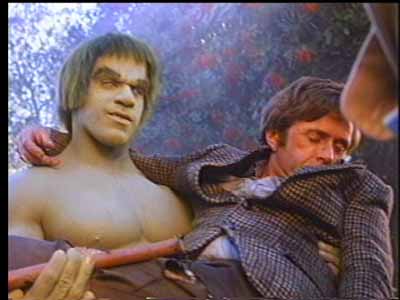
‘Mystery Man’ & ‘Mystery Man Part II’ (Aired 03/02/79 & 03/09/79):: this is the type of "Hulk" episode that drives fans of the comic book series (like my former best friend Rich) mad while thoroughly delighting those of us that hold this live-action series as the pinnacle of "Hulk" fandom. There’s a window of approx. 75 min. from the first ‘Hulk-out’ in Part 1, when Banner (as the Hulk) is badly burned by an automobile wreck he was riding on and eventually tosses around, and the second one in Part 2 when Banner is trying to save Jack McGee from falling into a ditch filled with hungry wolves in the middle of a raging forest fire. In-between these fan-anticipated appointments with the green one’s path of destruction we’ve been riding along as an amnesiac Banner, his face bandaged to cure facial burns and going by the hospital-issued generic name of ‘John Doe,’ interacts with McGee (who is unaware that it’s Dr. David Banner by his side) when the airplane taking them to an amnesia specialist goes down in the middle of nowhere.
With McGee’s badly injured leg preventing them from moving with ease and ‘John Doe’s’ memory coming and going sporadically, the two men spend an inordinate amount of time talking about themselves and their lives trying not to think about their dire situation. A raging fire in the distance and hungry wild animals on the prowl, John Doe/David Banner’s lack of awareness about his own hidden strength are effectively used to add tension to what otherwise be standard-issued survival of the fittest scenarios. It’s during the many aforementioned conversation scenes between McGee and Doe/Banner that both ‘Mystery Man’ installments shine their brightest, giving us an in-depth view of the Jack McGee character that wouldn’t resurface until the aforementioned Season Three episode ‘Proof Positive’ one year later. The lessons learned from his father’s unsuccessful business decisions and McGee’s desire to use the Hulk story as leverage so he can get ahead in his journalism career (a confession made to Banner when ‘John Doe’ has finally regained his full memory but is duty-bound to help the badly-injured McGee) reveal the reporter to be a selfish and flawed, but ultimately decent, human being.
You know, the same way Banner’s impetus and recklessness drove him to experiment with himself and cause his Gamma radiation overdose. One of the few infrequent opportunities in which "The Incredible Hulk" allowed its two principal actors (the one’s playing human beings anyway!) to interact with one another (‘Broken Image’ and ‘Equinox’ were two others), the "Mystery Man" saga places character development above needless Hulk-outs. It effectively reveals the Banner/McGee characters to be flip sides of the same coin that destiny has imposed on both of them to try to understand. Who cares that the creature’s feats of strength consist of tossing a few lame flaming trees and tossing over an already-wrecked car? Even the unusually outdated (and grainy as heck) stock footage of 50’s meteorologists and firefighters putting out forest fires, used repeatedly to drive home the point over-and-over-and-over-and-over again that the two main characters are in great danger, has a simplistic charm all its own.
DISC 5 - THE BEAST WITHIN
‘The Psychic’ (Aired 02/22/80): David Banner’s fear that his uncontrollable alter ego may kill an innocent person appears to have come true when witnesses report seeing the Hulk seriously injure teenage boy Robbie Donner. A twist of faith results in down-on-her-luck San Francisco telephone operator Annie Caplan (Brenda Benet), a woman with psychic abilities (i.e. being able to tell a person’s future by touching them when they’re in turmoil), running into David and immediately knowing what he becomes. Caplan’s desire to cash-in on the National Register’s $10,000 bounty for information leading up to the capture of the creature initially makes her rat out David. But, once she senses David’s heartfelt concern for the Hulk’s injured victim, Annie decides to help Banner avoid McGee. The death a few hours later of the teenage boy allegedly hurt by the Hulk and McGee’s ever-close snooping, however, become too much for David to bare. After crying his heart out in Caplan’s arms (second most gut-wrenching crying scene by David Banner after ‘The First Part II’) the tormented scientist seriously considers ending his own life by jumping off a balcony to spare the lives of more potential victims.
A chance touch by McGee, however, sends both David and Annie on a path that could potentially exonerate the creature from the death that’s been attributed to its name. This is a superior stand-alone "Hulk" installment on premise and execution alone, but Karen Harris & Jill Sherman’s teleplay (whether it was intended or not) stacks-up the episode’s sad parallels with those of the tragedies that afflicted its lead actors. Then-married acting couple Bill Bixby and Brenda Benet eventually separated and lost their only child to a tragic health affliction, which years later led to Benet ending her own life. When Benet’s Annie Caplan character tortures herself for the death of a missing child her psychic powers couldn’t properly identify, or Bixby’s Banner character cries his heart out when reading the news that his out-of-control alter ego has killed an innocent person, it’s hard not to think of Benet’s last few hours alive contemplating suicide or Bixby hearing the news of his son’s death for the first time. An unfortunate case of life imitating art, ‘The Psychic’ nevertheless shines as 100% pure "Incredible Hulk" sanctioned drama. The final scene in which Annie Caplan (whose last name is eventually revealed to be Cassidy) hugs Banner and sees his future (was it the Hulk falling off a plane to his death in "The Death of the Incredible Hulk" movie? :-P) is by itself worth the Box Set’s rather-steep asking price.
‘Prometheus’ & ‘Prometheus Part II’ (Aired 11/07/80 & 11/14/80):: by the time its fourth season rolled around "The Incredible Hulk" had established itself strongly-enough on CBS-TV’s schedule to take chances with its premise. "Incredible Hulk" creator Kenneth Johnson, whose ‘Pilot’ and ‘Married’ episodes went for ultra-dramatic realism over flashy storylines, decided to indulge into some of the outlandish comic book-inspired fantasies his show’s first three seasons tended to avoid with a two-part Season Four opener that is regarded to this date by "Hulk" fans as a TV sci-fi classic. ‘Prometheus,’ sadly, would prove to be Johnson’s final turn as writer/director of a "Hulk" installment. But man, if you gotta go you might as well go swinging. And Johnson swang harder, smarter and stronger in ‘Prometheus’ than he ever did before or since; not even his blockbuster "V" mini-series can compete with this two-part "Incredible Hulk" episode.
Named after a top secret military base in charge of tracking down meteorites and/or UFO’s that enter Earth’s atmosphere without alerting the civilian population ("The X-Files" anyone?), Prometheus’ advanced satellite technology eerly forecasts the crashing of a meteor somewhere in the United States. And what do you know? David Banner (who just happens to be in the area) eventually comes into contact with the aforementioned meteor while helping a blind woman who lives in area cope with her fear of wondering outdoors. The meteor’s Gamma radiation and some poe’d bees (don’t ask!) unleash Banner’s angry creature that, when calm overcomes it, ends up stuck in mid-transformation! Neither a full-blown Hulk or a meek human, this hybrid human/creature (played during long shots by actor Ric Drasin, the only actor besides Richard Kiel to have played either the Hulk or David Banner roles) is eventually angered enough by the U.S. military to turn into the Hulk and bring down a helicopter.
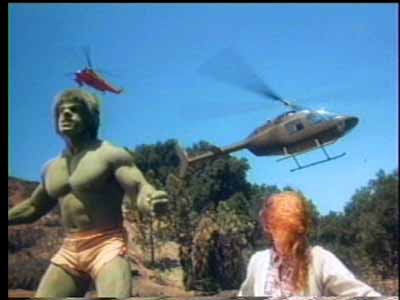
Thinking it’s an alien life form that came to Earth aboard the downed meteor (hey, didn’t "Men In Black" state that tabloid rags were the MIB’s source sheets?; doesn’t anyone at Prometheus read the National Register? :-P) the military decides to capture the creature alive. Captured in a titanium dome alongside the blind woman David met before the meteor crash, the Hulk is moved (first by helicopter and then by military convoy) into the depths of Prometheus for study. Jack McGee, disguised as a Prometheus crew member, sneaks into the secret military base and proves to be useful in helping the clueless scientists deal with the runaway creature once it escapes (and begins to destroy) all their modern day facilities. The End. :-) Besides being a great marriage of the somewhat believable and the outrageously fantastic (unlike the military’s battles with the creature in Ang Lee’s "Hulk" movie, which are totally unbelievable), ‘Prometheus’ also feels like a reunion of sorts for many distinguished guest performers of previous "Hulk" installments.
Laurie Prange, who was such an annoying whiner in the ‘Death in the Family’ TV movie, hits the right notes of vulnerability and toughness in the first half of ‘Prometheus.’ Whit Bissell ("I Was a Teenage Werewolf," the above-reviewed Season Two episode ‘Kindred Spirits,’ etc.), excels as the senior scientist without logical explanations as to what the hell it is that is tearing his precious secret lab apart (even when McGee tells him outright). I could even swear I saw Gerald McRaney in the background somewhere! :-P The real stars of ‘Prometheus’ though are Kenneth Johnson (assured and in control of a narrative that could have degenerated into pure silliness) and the production values; never have I seen a TV show from the early 80’s display the imagination, resources and budget that this two-parter throws at the viewer. No wonder Universal had to use stock footage for Prometheus’ final decimation and CBS-TV’s bean counters barked at the idea of sustaining the show’s huge-for-its-time budget. This two hour-long episodes alone look like they were each were worth more than a half-a-dozen "Hulk" shows put together.
DISC 6 - THE HIDDEN POWERS OF THE INCREDIBLE HULK
‘Dark Side’ (Aired 12/05/80): the three episodes in this disc are the only one’s that haven’t been readily available on any sanctioned U.S. home video releases until now, and they all belong to Season Four. ‘Dark Side’ is typical of your higher second-tier "Hulk" episodes (below classics like ‘The First’ and ‘Married’ but above forgettable crap like ‘The Lottery’ and ‘Jake’) that fans remember but are rarely able to recall. Like ‘Kindred Spirits,’ a giant leap of faith is asked from the audience when Banner’s latest cure attempt (an injection that seeks to control the aggressive side of his personality by directly tapping into the cerebral cortex) backfires. The elixir turns David’s nice human persona into that of a cold and selfish man that actually seeks conflict in order to hurt and potentially kill others; it’s "Sybil" meets "Dr. Jekyll and Mr. Hyde" within the body of a man that can turn into a real-life monster (within the show’s universe of course!). Writer Nicholas Corea and director John McPherson effectively use weird imagery (recurring gray images of David running away from men in weird Indian facial paintings meant to represent his wild side) and atmospheric shadows to clearly visualize the black & white state of mind that Banner has accidentally unleashed upon himself.
David’s good persona eventually struggles mightily to defeat his own devils (literally!), but not before he has bullied the crap out of the family he’s rooming with and seduced their somewhat-eager teenage daughter. To see Banner kick ass and seduce women with the same vulgar glee with which the thugs he usually ran into beat him makes ‘Dark Side’ more than worth sitting through by any hardcore "Hulk" fan. You thought Bixby’s suave gangster character in ‘Broken Image’ was bad? Wait ‘till you see ‘Evil David’ talk to a teenage girl like a "Law & Order: Special Victims Unit" pervert with remnants of chicken meat (... chicken... broken...) stuck to his sweaty face. Disgusting enough for you? For a TV show in which every episode had Bill Bixby turning one believable performance after another ‘Dark Side’ comes across as a welcome departure and a pleasant surprise. If Robert Louis Stevenson had been alive when this "Incredible Hulk" episode aired he would have re-written "Dr. Jekyll and Mr. Hyde" and demanded Bixby play both parts.
‘Deep Shock’ (Aired 12/12/80):: the only episode of the 18 featured in this Box Set that isn’t a two-parter and follows the chronological order of its initial airing (right after ‘Dark Side’), ‘Deep Shock’ starts promising and ends up drowning in its own self-imposed need to foreshadow its own scenes over and over and over... (30 min. later)... and over and over again. An accident at an electrical plant turns Banner into you-know-what when he tries to save an injured co-worker (played by Tom Clancy); then a loose wire proceeds to pass through Banner’s metamorphosed body with enough electrical power to keep the American Eastern Coast from blacking out. OK, it may not have been that much juice that flowed through the Hulk’s body, but it was enough to send David into a coma from which he eventually awakens with visions of the near-future. One of them, in which his Hulk persona apparently kills the co-worker he was trying to save, scares him enough to try to leave town before it comes to pass.
We the viewers, unfortunately, don’t have a choice in the matter and are forced to endure close to 40 minutes of Banner foreshadowing stuff that ends up appearing a few minutes later. Think of this as ‘The Psychic 2: Electric Bugaloo’ and it still fails to come anywhere near the high pedigree of quality one comes to expect from the better Season Four "Hulk" installments.
‘The Harder They Fall’ (Aired 03/27/81):: the last of the new-to-home-video "Hulk" shows continues the previous episode’s mini-trend of hospitalizing David Banner with a serious injury. Geez, for a guy that’s supposedly dead, without money and no identity Banner sure seems to rack-up mighty high health bills at hospital emergency rooms across America... but I digress! After being hit by a car and suffering what appears to be permanent paralysis of his lower half (turns out the Hulk cannot be unleashed unless David is conscious of the pain, a strategy one too many thugs abused throughout the show’s run by clunking Banner on the back of the head) the fugitive scientist falls into a deep depression. He even considers hurting himself with a broken glass in order to unleash the self-healing aspects of his metamorphosed state, one of the least explored (and often overlooked by fans) benefits the Hulk transformations bring to the otherwise-battered physique of Mr. Banner’s human form.
David is eventually pulled out of his funk by another wheelchair bound patient (played by Denny Miller, who was memorable as a professional football player with anger management problems in a Season Two "Hulk" episode whose name escapes me at the moment) that has a positive outlook on life and a potential bank loan at the ready to start his own business. When this loan is turned down by a bank he accuses of having a double-standard when dealing with handicapped people, David’s friend decides to use his starting pistol to get what he feels is owed to him. Bixby and his stunt doubles show great courage in their scenes as wheelchair bound patients, never sugar-coating the hardship of this condition. The bar fight in which David is pushed down a flight of stairs (can’t this guy ever catch a break?) is kind-of retarded but it allows Ferrigno, who usually just has to stand around flexing his well-developed muscles for the camera, to perform some serious body language action. The Hulk’s palpable anger at his inability to move the way he’s used to (and his primitive brain’s lack of understanding as to why his legs won’t work) brings the vulnerability of Banner’s crippled condition to vivid sci-fi life. It’s one of the best moments, scene-wise, of the entire series.
Too bad the scene right after the one mentioned-above shows David back in his hospital bed impressing his doctors with his sudden recovery. Where did David come to after the Hulk calmed down? How did he get to the hospital if he still can’t walk? Why would there be no information of who Banner (or whatever his made-up name last name was time) was at the hospital where he was staying (picture, finger prints, spinal chord operation records, etc.) when McGee eventually comes knocking down? Despite ending the DVD Box Set’s 18-episode selections on a high note the lapses of common sense logic prevalent throughout ‘The Harder They Fall’ were early signs that "The Incredible Hulk," toward the end of its next-to-last-season, was already beginning to run out of gas.
And there you have it. Lots of good and not-so-good episodes (IMHO), which together provide a slice of late 70’s/early 80’s science fiction heaven worth rediscovering again. Don’t forget Universal’s stand-alone ‘Pilot’/’Married’ DVD from a few months back if you choose to purchase this DVD Box Set. It‘s an indispensable indoctrination for watching, understanding and truly getting the heart and soul of what Kenneth Johnson’s "Incredible Hulk" TV saga was all about. Newcomers to this show will be surprised to find what its hardcore fans (like yours truly) already know: there’s more to David Banner’s quest for a cure to rid himself of ‘the creature’ (AKA ‘The Hulk’) than ripped clothes and tossed-over cars. There’s more emotion, tragedy, pathos, drama, excitement and tears (of joy, elation, sadness, anger and a galaxy of other human emotions) in one minute of the better episodes of "The Incredible Hulk" than in the entire running time of Ang Lee’s "Hulk" movie. And "Battlestar Galactica"? Fuggetabaut.
The Disc:
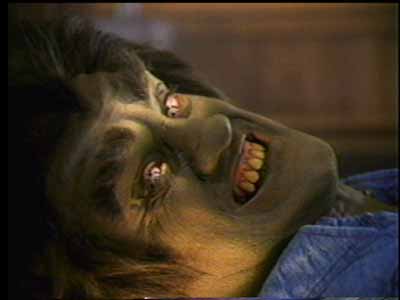
Universal obviously spent a King’s ransom putting together "Battlestar Galactica’s" Box Set (reviewed elsewhere today by yours truly here on PSXNATION); the packaging, digital remastering and remixed Dolby 5.1 soundtrack for this TV series are as good as money can buy. This only makes it all the more heartbreaking (and obvious) that mere pennies were spent with "The Incredible Hulk’s" Full Screen (1:33:1) Video Transfer & Dolby Digital 2.0 Mono Soundtracks. Even the Subtitles (English Closed Captioning) and lackluster menu screens reek of a rushed schedule in order to get this Box Set released in time to coincide with the release of Universal’s big-budget "Hulk" movie. Check out the scene early in the second part of ‘Death in the Family’ (‘The Race Against Time’ Disc) when the Hulk transforms back into David Banner in the swamp. Wow, I’ve seen 1930’s newsreel footage with less faded colors and film imperfections than what the original print of this particular photoplay displays!
Most of the 18 hour-long episodes in this Box thankfully don’t look as bad as the above-listed scene, but the reliance of "The Incredible Hulk" show on lots of grainy stock footage (‘Mystery Man 1 & 2,’ for example, goes a little crazy with its old film of 50’s/60’s firefighters and weather forecasters) really hurts the show’s visual appeal. The actual footage of the show itself ain’t that bad when what is meant to be a full screen shot isn’t zoomed into a close-up for dramatic effect (another practice common of 70’s hour-long dramas). A small increase in sharpness, better resolution and the relatively decent color/skin tones (an important detail when one of the show’s attractions is a giant green creature) is noticeable when viewed side-by-side with Columbia House’s lot of "Incredible Hulk" VHS tapes. While the early episodes from ‘77 are grainy and often border on unwatchable (‘Death in the Family 1 & 2’ in particular) the last one’s from ‘81 (like ‘The Harder They Fall’) look about as good as early 90’s material. They might not look perfect, but this is the best these "Incredible Hulk" shows have looked in a long time.
The original 2.0 Mono soundtracks, surprisingly, don’t fare as badly as one might think given the show’s often-used (and quite distracting) practice of splicing lines of A.D. dialogue for off-screen characters. Joseph Harnell’s music ranges from deeply touching (I have yet to grow bored of listening to the ‘Lonely Man’ closing credits piano theme) to exciting (the opening theme) and everything in between. The Hulk’s roar (NOT done by Ferrigno BTW) and his weekly orgies of destruction lack the oomph they might have had if the soundtrack were Remixed in Dolby 5.1. It’s amazing how many technical shortcomings one is willing to forgive when the photoplay one is watching is so damn well-made story & acting wise; I’ll take this Box Set’s "Hulk" Mono soundtracks over "Battlestar Galactica’s" Remixed Dolby 5.1 tracks any day, and twice on Saturdays AND Sundays. Speaking of Box Sets, the Digipak Box Set Design uses very stylish profiles of the show’s stars with various shades of dark and green. Very cool and in tune with the TV series’ darker-than-the-comic-book tragic undertones.
bottom line:
I’m so elated and saddened! The existence of this Six-Disc Box Set pretty much kills any short-term chance me and other "Incredible Hulk" fans had of owning all 80+ episodes of this deeply moving, Kenneth Johnson-developed take on Marvel’s comic book hero on DVD. This sucks! On the other hand the handful of Home Run/AAA/bonafide classic two-part and stand-alone installments ("Prometheus 1 & 2," "The First 1 & 2," "Mystery Man 1 & 2," "Dark Side," "The Psychic," etc.) far outweigh the inferior shows ("Death in the Family 1 & 2," "Stop the Presses," etc.) that crept into the mix. The unremarkable video/audio transfer and lack of bonus features hurts, but doesn’t completely sour, the thrill of finally owning "The Incredible Hulk" on the best home video format to date. It might not be quite ‘Ultimate’ enough for hardcore "Hulk" fans like myself, but its not like we have achoice! :-(.
By - J.M. Vargas