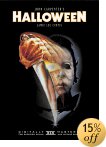
When they set to do a low-budget horror movie about an escaped mental patient that goes back to his hometown for a killing spree on the anniversary of the day he brutally stabbed his older sister to death, writers/producers John Carpenter and Debra Hill had no idea they were laying the foundation for what would become one of the most relentlessly copied horror movie formulas in the genre’s history. You’d think "Halloween’s" body count (five dead, plus two dogs), tame-by-today’s-standards gore (blood is not shown in copious or even disturbing amounts), blink-and-you-miss-it nudity and
‘he’s not really dead’ finale would be deadly dull and boring in the year 2002. But, as yours truly found out when he sat down in his New York City studio apartment with the lights turned down and the home theater system’s sound cranked real high, Anchor Bay’s DVD version of the 1978 Carpenter-directed flick can still send a shiver or two down the spines of even the most jaded review critics. It might be about to turn 25 years old, but
"Halloween" is as effective in manipulating today’s DVD audience into paranoid fits of fright as it was in movie theaters over two decades ago..
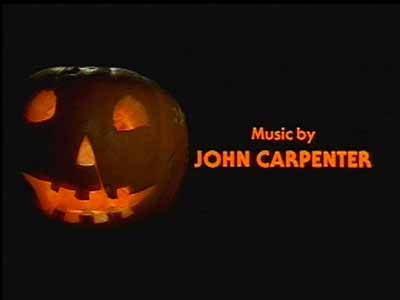
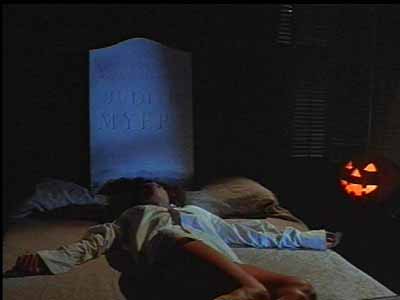
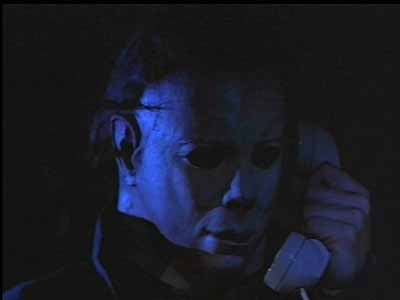
The tone of the movie is set during its opening credits, when John Carpenter’s masterful music score gives way to a first-person view of someone killing a young woman named Judith Myers with a kitchen knife on October 30th, 1963. This leads to the revelation that it’s a young boy named Michael Myers that has killed his older sister, effectively shocking the audience into stupor at the thought a person this young could be capable of such behavior (which was certainly more atypical back in 1978 than 2002). Fifteen years later and on the same date (October 30th) we watch as the young man’s psychiatrist, Dr. Sam Loomis (Donald Pleasence), is driven in the middle of a storm to the Smith’s Grove mental institution to transfer a grown-up Myers to another location. Before you can say ‘atmospheric use of darkness and music to scare the audience yet again’ (!) Myers hijacks Dr. Loomis’ car and drives away into the night. Convinced he’s headed back to Haddonfield Dr. Loomis chases after Michael, finding along the way that he’s gotten himself a new set of mechanics clothes (from Phelps garage for those keeping track of their "Halloween" trivia), a pale white mask and the tombstone that marked the graveyard where his sister Judith’s body was buried.
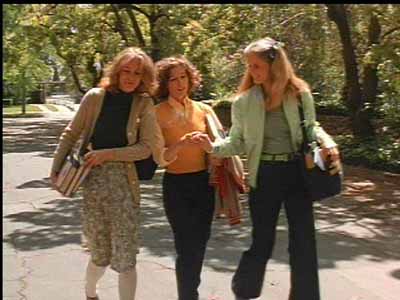
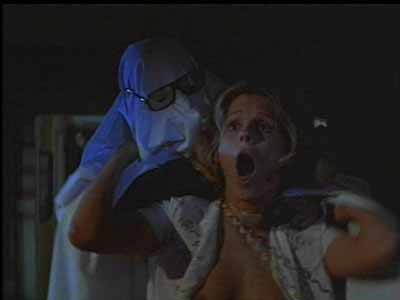
Then its time to meet the new unfortunate victims of Mr. Myers’ insane thirst for killing, which writer/director Carpenter never explains or sets-up as anything more than pure evil taking place on the evening of Halloween. There’s braniac Laurie Strode (Jamie Lee Curtis in her motion picture debut), her best friends Linda (P.J. Soles, AKA Norma from Brian DePalma’s "Carrie") & Lindsey (Kyle Richards) and their boyfriends Bob (John Graham) and Tommy (Brian Andrews). [ED.: FYI, Carpenter and Debra Hill would only introduce the ‘Laurie is Michael’s sister’ plot gimmick in the sequel, so the movie’s best enjoyed if you assume everyone who is a victim just happened to stumble upon Michael Myers’ path by accident. Or you’re free to watch it already knowing how the sequels twisted the story to their own advantage, your call]. The acting is unremarkable and plain from all involved, and Curtis had yet to blossom into the scream queen of teen slasher flicks that she eventually became known for. The simplicity of the performances works well with Carpenter’s ever-present score, well-framed camera angles and cinematographer Dean Cundey’s masterful use of darkness and shadows to conceal from the audience the spot from which Myers is going to pop-up and do his deadly bogeyman deeds.
The film’s tension and sudden outbursts of brutality (much of it concealed by the darkness of the night, and some of it even aimed at helpless dogs) are made more shocking and unbearable by how restrained and realistically everyone plays their parts. Unlike today’s contemporary horror flicks that openly ‘wink’ at the audience to remind them that it is just a movie, "Halloween" plays it straight through and through and its ending (implying evil wins by not dying and always hanging around every corner that its victims know so well) would have been that more effective had the sequels not messed it up so much by now. The 70’s era evoked by the fashions and forgotten traditions seen here (does anybody still watch old b&w horror movies on October 31st anymore?) also contribute in keeping "Halloween" a fresh viewing experience while also safely keeping it stuck in a time capsule of sorts. One can watch "Halloween" and not be horrified by how outdated it looks while also being reminded that today’s filmmakers rarely make horror movies like this anymore (with notable exceptions like M.Night Shayamalan’s "The Sixth Sense"). One can’t say the same about "The Hills Have Eyes" or "Phantasm," right?
Simply put, John Carpenter’s "Halloween" is still a classic worth revisiting the way it was meant to be experienced: in a dark room with a 16X9 widescreen TV set and the sound system cranked to the max as its hooked-up to your DVD (PlayStation 2?) player. Yellow stains on the carpet and neighbors knocking on the door when they hear you scream at your set don’t come included with Anchor Bay’s DVD, but are welcomed benefits of inviting Michael Myers into your home nevertheless!
The Disc:
Beware of something called "Halloween: Extended Version" (also from Anchor Bay) that is being sold dirt-cheap at DVD retail establishments. It’s just the ’78 version of the movie plus pointless filler material shot by the producers of "Halloween II" to pad the length of the edited version of "Halloween" once the Standards and Practices (AKA censoring butchers) of NBC were done with it for its Network TV premiere. It looks OK, but lacks the special features and much-improved soundtracks that the regular Anchor Bay DVD edition of "Halloween" offers. Consider yourself warned.
The THX certified Widescreen Anamorphic (2:35:1) and Full Screen (1:33:1) Video Transfers (both on the same side of the dual layered disc) of "Halloween" on DVD are littered with a perpetual case of grain and dirt imperfections, as well as flesh tones and color palettes that can’t hide the movie’s low-budget film stock at the time of its creation. These flaws, however, are bearable given the complete lack of any compression artifacts whatsoever. A movie like "Halloween" requires the absolute best possible representation of pitch black darkness in order to both convey its dreadful mood and hide the spot from which the killer will jump. That’s exactly what Anchor Bay’s DVD provides (accept no substitute folks), along with a remastered English Dolby Digital 5.1 Soundtrack that is nothing short of remarkable; English Dolby Digital 2.0 Surround & Mono Tracks are also offered, but skip them if possible. From wind blowing through the trees to John Carpenter’s still-disturbing music score (a creepier horror song I can’t think of) and Michael Myers’ heavy breathing, "Halloween" has never sounded as good as it does on Dolby 5.1. No subtitles of any kind are offered.
A commentary track would have been a nice bonus feature in this "Halloween" DVD; Carpenter and producer Debra Hill are no strangers to sitting in front of a microphone to talk about their work (the best and most recent example being MGM’s recently-released DVD for "The Fog"), but I guess it wasn’t meant to be. What we get instead is ’Halloween Unmasked 2000’, a 27 min. documentary in which the principal actors and crew members involved in the creation of the movie reminisce about its impact on their careers as well as the movie industry. Talking heads and still pictures compromise most of the documentary, with only a handful of clips used to pad the length of the piece; it could have been a little bit longer and be more insightful into how these people feel about the inferior sequels that followed, but for what it’s worth it informs and entertains in equal measure. Carpenter’s anecdote about how he came up with the score for the movie under time constraints in three days is just priceless, as are the stories of how well audiences at the time received what would become the most successful independently-produced movie of its time.
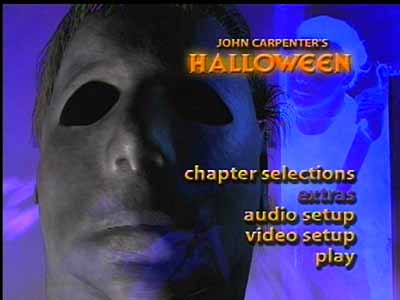
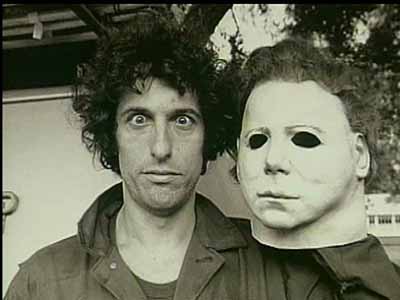
There are also two Theatrical Trailers (95% identical except for a little re-release tag at the start of the second one), three TV Spots, three Radio Spots (with the TV and radio spots recycling video/sounds from the theatrical trailers), a Still/Poster Gallery (61 images of publicity material), a Behind-The-Scenes Still Gallery (100 on-the-set pictures, including one of the men behind Michael Myers’ lifeless mask), a Trivia section (production notes that recycle information already covered in the documentary or elsewhere) and an in-depth Talent Bios section covering seven actors or crew members involved with the creation of the movie (including financier Moustapha Akkad, the only person associated one way or another with every "Halloween" movie ever made). Doesn’t seem like much, but if it helps keep the actual movie’s dark portions look pitch black and without artifacts I’m plenty satisfied.
bottom line:
24 years and a gazillion inferior copycats later (many from the series that bears its name), "Halloween" still earns respect the old-fashioned way: by being a restrained, well-paced, gorgeously-lit and eerily-scored horror movie that can still scare. Anchor Bay’s THX certified video and audio transfers for the DVD pass muster (Carpenter’s score alone will make anyone squirm in their home theater den), and the extras put the film in its proper historical perspective as one of the horror genre’s biggest stars. Track it, rent/buy it and marvel at how well this once-fresh formula can still disturb and entertain young and old alike. A true horror classic in every sense of the word.
By - J.M.'The Horrormeister'Vargas
 1/2