In the summer of 2001 me and my father went to our first Major League
Baseball game together in Arizona. He's in his mid-50's and I was 28 at the
time. We watched as the Diamondback's took on the San Francisco Giants. We
watched Barry Bonds hit two home runs and the manager of the team being
ejected for unsportsman-like conduct. The Diamondbacks ended up winning
though, and me and my father cheered and jeered like we gave a damn about
either team. Neither of us had ever seen, cared or given two damns about
baseball, yet to this date me and my dad treasure that memory as one of the
few times we bonded together. Is unlikely that we'll ever go to another
baseball game though, since he lives in Arizona and I work in New York City.
Plus we really don't like baseball all that much and we don't get along too
well with each other, if you know what I mean.
I'm sure that you all have your own particular memories about baseball,
father-son relationships and/or meditations about what we all wish we could
have said or done to long-lost relatives that are no longer with us. That's
what makes Phil Alden Robinson's "Field of Dreams" the quintessential
American movie for all three of those subjects, and one of the most subtle
and gentle star vehicles with which actor Kevin Costner became associated
with the way Hollywood portrays the sport in movies (along with Sam Raimi's
"For Love of Game" and Ron Shelton's "Bull Durham"). Costner plays Ray
Kinsella, life-long baseball fanatic and hard-working Iowa farmer that's
married to lovely Annie (Amy Madigan) and is father to a cute little daughter
named Karin (little Gaby Hoffman). Life couldn't be more simple or
uncomplicated for Ray until he hears in his corn field a mysterious voice
telling him: 'If you build it, he will come'. With the support of his wife
and the perpetual ridicule of his brother-in-law (played with sarcastic
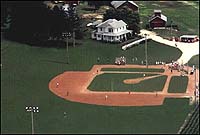
delight by "Thirtysomething" star Timothy Busfield), Ray builds a baseball
field in the middle of his corn field.
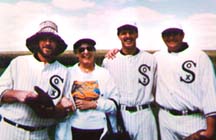
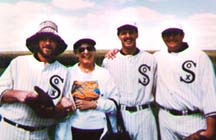
Then, a few nights into his madness, a player from the scandalous White Sox
team that threw away the World Series in the early part of the century
appears in the Kinsella's new baseball field. He's 'Shoeless' Joe Jackson (a
pre-"Goodfellas" Ray Liota), and his baseball friends also come over to play
at Ray's. Through chance, circumstance and a lot of coincidence (not to
mention a tremendous leap of faith by the screenplay that Phil Alden Robinson
adapted from W.P.Kinsella's "Shoeless Joe" novel), Ray decides to use his
field's magical ability to draw baseball players from the past to correct the
lives of men that loved the sport but weren't able to fully explore their
ability to play the sport. One of them is author Terence Mann (James Earl
Jones) that parallels the career of "Catcher on the Rie" author J.D.Salinger,
and another one is a small-town doctor named Archie 'Moonlight' Graham
(played by Burt Lancaster as an old man and Frank Whaley as a young man) that
only played once in the majors and then disappeared into a life of
normalcy.
The interaction between these disparate characters, held together by
Costner's no-nonsense performance and the measured direction by Phil Robinson
(the man behind this summer's Ben Affleck/Morgan Freeman flick "The Sum Of
All Fears"), carries "Field of Dreams" through story-telling loopholes that
could have sunk a lesser film. The payoff at the end is both humane, poetic
and intellectual, while also being subversively funny as a contrast to the
money-making machinery that the sport of baseball has become in contemporary
times. Magical and spellbinding, "Field of Dreams" is a sports movie that
transcends its sports niche appeal and becomes a comment on man's most basic
desires. Irresistible summer-viewing entertainment.
The Disc:
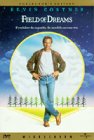
This Collector's Edition DVD features a Widescreen Anamorphic Video
Transfer (1:85:1 aspect ratio) that feels a tad washed-out and
discolored. The image wasn't that sharp to begin with due to Director of
Photography John Lindley's decision to shoot the movie with a soft-focus look
to enhance the dream-like quality of the story. On the big screen the
picture must have looked fine, but the transfer to DVD has resulted in images
that look more like they came from a 1970's Terence Malick movie rather than
the 1989 summer drama it actually is. There are visible instances of dirt,
grain, film scratches and, just for kicks, artifacts from data compression.
The sound is also a disappointment and consists of two average and
unremarkable English and French 2.0 Surround tracks that keep
the dialogue audible and the sound effects decent (no harm, no foul).
English and Spanish Subtitles for the hearing impaired are also
available.
Then there are the bonus features that in this Collector's Edition DVD
compensate for their quantity with quality. 'The Field of Dreams
Scrapbook' is an 88 min.-long documentary that thoroughly documents
with pictures, on-location home videos and talking-head interviews (from the
1980's as well as more recent one's) the journey that W.P.Kinsella's
"Shoeless Joe" novel took as it was adapted for the big-screen So thorough
it feels like Ken Burns his own self had his magic touch on the subject
transplanted into its narrative, you won't have a single question left
unanswered (or an actor cliché' not shown on-screen twice) about this movie
after you've seen this video scrapbook. Complementing the documentary is a
Feature-Length Commentary Track in which writer/director Phil
Alden Robinson and Director of Photography John Lindley talk about the trials
and tribulations of shooting on a cornfield in the middle of Iowa. There's
also the movie's Theatrical Trailer and Production
Notes recycling the same information covered on the documentary and
commentary track. Whoever said that size does matter hasn't checked out the
depth and quality of the few bonus features with which the Collector's
Edition of "FOD" enhances tremendously the viewing experience of an already
great motion picture.
bottom line:
Kevin Costner owns the baseball genre with this and "Bull Durham",
arguably the two finest movies ever made about America's favorite summer
pastime. Religious parable? Science fiction? Fantasy? Nah, just what
happens when visual poetry and allegory collide to create low-key family
drama of the highest-possible order. This coming from someone that has never
liked, cared about or given a damn about baseball.
By - J.M. Vargas