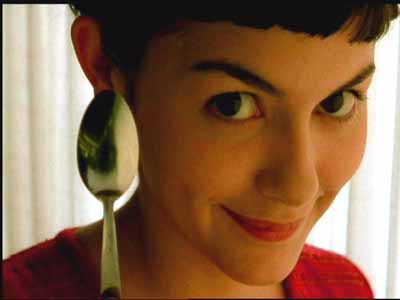
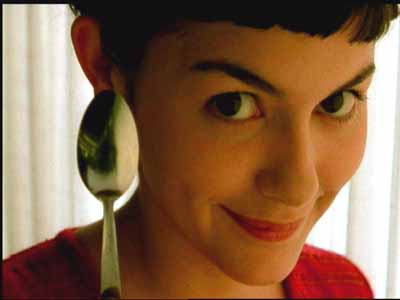
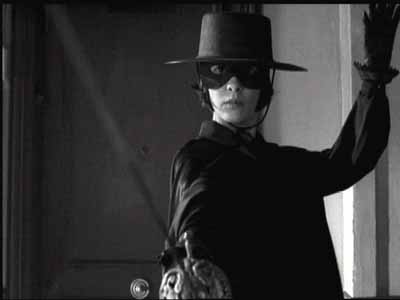
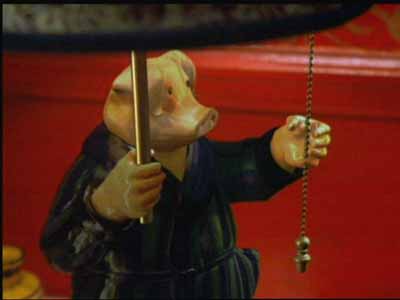
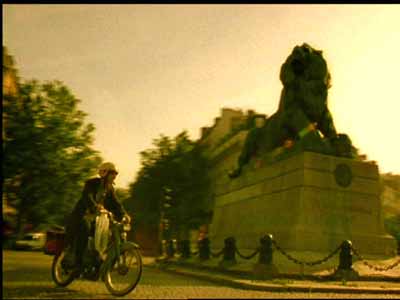
If the mental illness and self-inflicted depression of the characters in "The Hours" leave you strung-out, you're not alone. The good thing about well-made but humor-free dramas like "The Hours" is that it leaves its viewers ready and willing to laugh and enjoy themselves silly when/if the right movie/TV show/visitor comes by their TV set/home. If Nicole Kidman's portrayal of Virginia Woolf leaves you with the need to see European women on-screen that don't smoke like a chimney or contemplate ending their lives because of a self-imposed moral quagmire, may I recommend you take another look at Jean-Pierre's 2002 masterpiece "Amelie"? An argument could be made that the lead character of this ultra-successful and critically acclaimed French fantasy, Amelie Poulain (Audrey Tautou, currently starring in Stephen Friars' "Dirty Pretty Things"), is as deranged and mentally cuckoo as any of the women in "The Hours."
How else to explain the women's obsession (via mental daydreams or covert little actions) with making the lives of those around her better at the expense of her own happiness? Like Meryl Streep's Clarissa Vaughn character in "The Hours," Amelie lives an emotionally empty life that only seems to come alive when she wants to make good things happen to other people (the result of a successful reunion between an old man and his lost box of memories, Chapters 3-5). Or, like Richard Brown (the Ed Harris character), the young Amelie suffers a negative trauma in reverse. The sudden death of her domineering mother by receiving the full weight of a suicide jumper outside of church (don't ask!) frees Amelie from using her imagination, the same way that Laura Brown's (Julianne Moore's character) abandonment of her young son (and family) truncates her youngster's life choices. It might seem weird to you that I'm comparing an American-produced drama with a French fantasy/comedy, but indirectly both deal about the same common theme: how to deal with repressed emotions that exist only in the minds of those that conceal them. "The Hours" deals with them in the most straightforward way possible, while "Amelie" goes for broke with cinema-fueled hallucinations and daydreams galore.
Hollywood is usually accused of being an assembly line of manufactured dreams that gives the world its cue about what to wish for, what to aspire to and what to desire for our lives (culturally, emotionally, materialistically, etc.). If "Amelie" proves anything is that the French (or any gifted filmmaker with the proper resources) are just as skilled at the art of manufacturing their own fantasies, only theirs can deal with anxiety and unfulfilled emotional desires by using laughs instead of a Philip Glass-composed score. What would Amelie Poulain be like if she didn't have all her self-imposed little adventures to help other Parisians occupying her mind? What if she didn't help her apartment building concierge, Madeleine Wallace (Yolande Moreau), rekindle her love of the man she has forgotten by fabricating letters that arrive in Madeleine's mailbox? Or if she didn't force her father Raphael (Rufus) to go out of the house for a trip after the pictures of his world-traveling garden gnome keep arriving (also in the mail)?
She'd be forced to look at herself and her meaningless and pathetic day-to-day existence, which might not be as fun a sight as that of her mean corner grocery owner Collignon (Urbain Cancelier) fumbling and bumbling all over his apartment after Amelie has re-arranged the furniture? In fact, it isn't until Amelie's quest to discover the identity of the man that collects discarded photographs from Parisian photo booths (Mathieu Kassovitz's Nino Quincampoix) that she stumbles upon the very real possibility of falling in love with an actual human being that reciprocates. Rather than happiness or giddiness, Amelie turns Nino's quest to find her into another of her cat-and-mouse routines (her method of preventing emotions she doesn't want to experience from surfacing, but which she can't bring herself to completely suppress). Oh yeah, just in case you weren't getting what I'm talking about, "Amelie" is a feel good, sugar coated, utterly-fantastic and funny French comedy for the ages. It also has its dark underbelly, one so skillfully implied and buried underneath its charm by director Jean-Pierre Beunet that it doesn't emerge on repeat viewings (or until you watch it on DVD right after "The Hours" :-P).
The Disc:
Who says all foreign films look cheap and have no production values? True, most older movies from overseas bear the ugly scarring of father time and inadequate storage of its source material (witness the sadness that is Fritz Lang's "Metropolis" with many a scene missing in its most recent DVD incarnation). And true, many foreign films still have to sacrifice film stock quality in order to afford the technical competence that comes expected from most American-produced Hollywood films. "Amelie's" Widescreen Anamorphic (2:35:1) Video Transfer, however, more than stacks the deck in favor of the foreign films. Yes, the DVD of "Amelie" really looks that good! Excellent saturation of colors, Bruno Delbonnel's dream-like cinematography and a camera that never wants to stay put (finally: crazy-cool camera angles that enhance a story rather than distract from it) give "Amelie" the look of a hyper-active cartoon brought to realistic, live-action life.
Ditto for the movie's French 5.1 Surround Audio Track, which makes every Paris traffic sign, pedestrian scream, urban noise, puddle of water and line of dialogue sound as if it were being uttered right next to your love seat and/or entertainment center. Yann Tiersen's playful music score has never made an accordion sound sexy or fun to listen to, which is remarkable given that "Amelie's" main theme consists of a few bars of music that (a) are endlessly looped throughout the movie and (b) sound no different than circus or carnival songs we've all heard a million times before. Thank God the powers-that-be at Miramax didn't include a dubbed English track (ala "Pinocchio" or "Crouching Tiger, Hidden Dragon"), since part of "Amelie's" charm is its weird but charming reliance of 100% pure French cultural iconography. English (Closed Captioning as well as standards fonts) and Spanish Subtitles are included for us, foreign-speaking Americans, to follow along with the movie's French sounds.
Other bonus features in disc 1 include Sneak Peaks (AKA trailers for other Miramax movies, DVD's or assorted products like "Amelie's" soundtrack) and Two Commentary Tracks with Director Jean-Pierre Jeunet. One's in English and the other one is in French, which I guess is far given the absence of French subtitles! While I'd like to know what intimacies Mr. Jeunet is sharing amongst his fellow French-speaking countrymen the man's comments in understandable English are plenty interesting in their own right. Before I move on to disc 2 I should mention that the menu/option screens of "Amelie" are a nightmare to navigate through. While each screen features moving images and a still portrait of a specific scene/character from the film (lots and lots of them!) the links are clustered at the bottom of the screen in tiny fonts that are hard to read and must be clicked one after another to arrive at the desired selection. It's a mess, but it speaks volumes about the quality of the special features that I managed to go through all of them, got more and more pissed-off as I went along and still felt compelled to give "Amelie" the score of 5 it so richly deserves.
On to disc 2, where the good bonus stuff has been condensed and arranged in quite a messy and hard-to-follow order. 'The Look of Amelie' (12:50 min.) is a featurette in which crew members explain how they drew inspiration to create the surreal worlds in not only "Amelie," but also "Delicatessen" and other films from director Jeunet. 'Fantasies of Audrey Tautou' is a 2 min. compilation of outtakes that seem to exist only for those viewers that want an uninterrupted two-minute look at Tautou's face (can't fault them for that!). Screen Tests are the audition tapes of the aforementioned Tautou, Urbain Cancelier (AKA the mean grocery owner) and Yolande Moreau (AKA the lonely concierge). An English Q & A With Director Jean-Pierre Jeunet (24:34 min.) recorded 1/9/2002 at an American Cinematheque gathering in Los Angeles and a French Q & A With the Director and Cast (5:54 min.) give "Amelie" viewers a chance to hear/see the performers up-close. A lame minute-long Storyboard Comparison is next, followed by a 21 min. Intimate Chat with Jean-Pierre Jeunet in which the director talks to the camera (i.e. the viewer) directly. Jeunet's comment about how listening to the DVD commentary tracks by Sly Stallone in "Rocky" and M. Night Shayamalan in "The Sixth Sense" inspired his own DVD comments in "Amelie" are particularly interesting (especially because Shayamalan didn't do a commentary track for either the Vista or standard DVD versions of "The Sixth Sense"... mmpphhhh!).
'Home Movies: Inside the Making of Amelie' (approx. 13 min.) are behind-the-scenes home videos (shot and edited by someone named Liza Sullivan) of the cast & crew of "Amelie" either hard at work or doing goofy chin puppetry for the camera. Trailers and TV Spots houses the film's American and French theatrical trailers as well as 12 (!) U.S. TV commercials and five French TV Spots. 'The Amelie Scrapbook' (which gets its name from the movie's photo album premise and end credits sequence) presents dozens of pictures/posters sub-divided into Behind-The-Scenes Photos, French Poster Concepts, Storyboards and The Garden Gnome's Travels (a funny collection of the photos the Raphael Poulain's character receives throughout the movie). Last, and certainly not least, there are Cast and Crew Filmographies for Audrey Tautou (naturally!), Mathieu Kassovitz and co-writer/director Jean-Pierre Jeunet. Phew! As if that weren't enough, check out "Amelie's" cool Custom 2-Disc Keep Case that can fold so you can have a circular portrait of Amelie as either a grown woman or a very small child. Fine stuff all around, and a fitting resting place for one of France's most infectious imports besides the common sense to stand against the United States' misguided war policies against Iraq (IMHO).
bottom line:
How can I follow the advice of Fox News' Bill O'Reilly and boycott the French? That would mean depriving myself of the works of Francois Truffaut, Sacha Guitry, Jean Renoir and Jean-Pierre Jeunet (maker of "Delicatessen," "The City of Lost Children" and... drumroll please... "Amelie"). A movie should be judged by the long-lasting effect it has on you long after you've exited the theater or ejected the disc(s) from the DVD player. By that measure (or any other you'd care to apply) "Amelie" is an unqualified success, a modern-day fairytale that remains as enchanting and delightful today as it was two years ago. 'Vive Audrey Tautou' (and f*** you Bill O'Reilly!).
By - J.M. Vargas