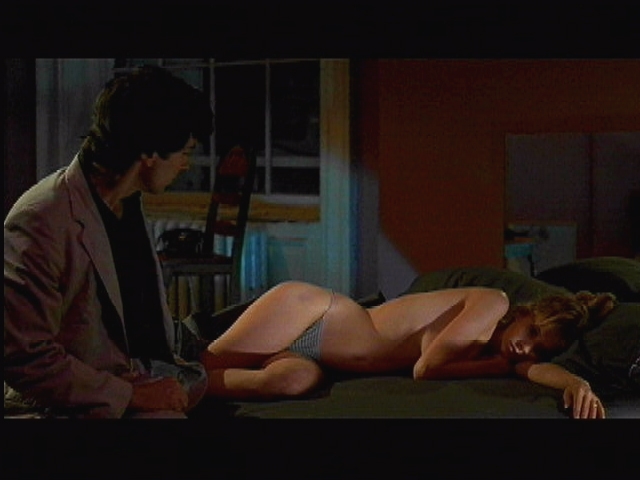
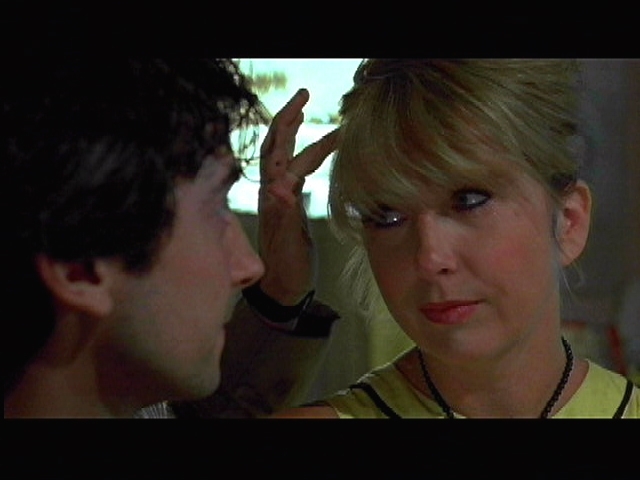
Paul Hackett (“An American Werewolf in London’s” Griffin Dunne), an average New Yorker that works as a measly computer operator, meets an attractive young woman named Marcy (Rosanna Arquette) at a coffee shop. She gives Paul the phone number of the Soho loft in which she’s spending the night with a sculptor friend named Kiki (Linda Fiorentino), and promises him that for his troubles he’s guaranteed to have a bagel-shaped paper weight (!). Paul calls the number and is invited by Marcy to go spend the night at the Soho loft. On his way to downtown Manhattan the cab ride is so fast and violent (as they usually are!) that Paul’s $20 bill, which is all the money he has, flies out the window.
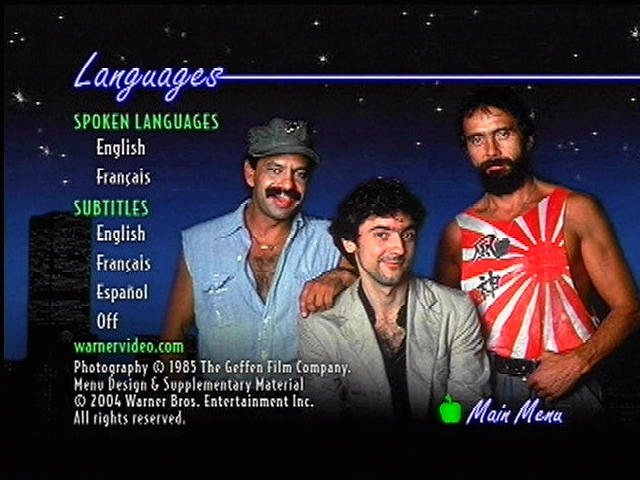
This is the first of what becomes a never-ending series of obstacles that line up between Paul and a safe return home from his initial attempt to have a romantic relationship with Marcy. In no particular order they include (a) Paul being accused of being a burglar terrorizing the Soho neighborhood, (b) a couple of burglars (Thomas Chong and Cheech Marin) obsessed with a paper statue, (c) Paul’s behavior causing a character to kill herself, (d) Paul losing the keys to his apartment by exchanging them with a bartender (John Heard) that (e) turns out to be Marcy’s boyfriend, and so on and so forth. By the end of the movie Paul is running for his life from a mob of Soho residents (and an ice cream truck!) and, while not quite believable, seems to be unable to leave downtown Manhattan.
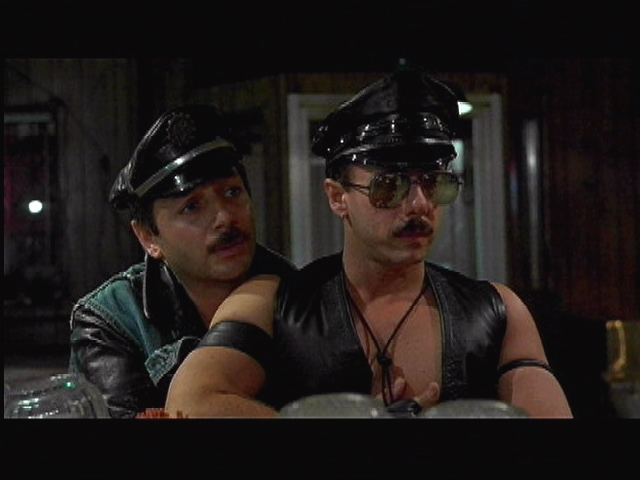
An unusual return to the low-budget roots of Martin Scorsese’s early work (particularly “Mean Streets”), “After Hours” relishes using odd camera angles and a surreal tone to make Paul Hackett’s nightmarish one-night stand in Soho seem both wholly probable and utterly impossible. The actors are given free reign by Scorsese and Joseph Minion’s screenplay to inject their roles with quirkiness. Teri Garr (as a waitress stuck in the 1960’s) steals the few scenes she’s in, as does Will Patton as Kiki’s belts & leather nightclub friend and John Heard as Marcy’s strange(d) significant other. These are only three of a boatload of actors that exploit the perception of New York City as a town full of weirdoes to inject their characters with memorable little scenes. Even Scorsese pays a loving homage to late night NYC cab rides in the 1980’s that are a far cry from his portrayal of that profession in “Taxi Driver” a decade earlier.
As is the case in most Scorsese movies set in NYC though, the city is as important a character in “After Hours” as the individuals populating it. Desolate streets, neon lights and rain puddles inject the Soho locations in which the movie unfolds with a menace not unlike the genuine article. It’s sad that these same streets have been turned into commercialized boutiques and trendy cafes since the movie was made, but I digress! Take it from this New Yorker that, like Paul Hackett, has found himself lost in the same neighborhood and unable to easily find a way out (though it only took me 10 minutes to take a cab out of there). Speaking of Paul Hackett, he is the audience surrogate in this trip into urban hell. As played by Griffin Dunne Paul is the 9-to-5 guy whose safe existence is thrown into chaos when the dares to step out of his apartment after 11:30PM, a time by which he’s probably asleep or watching late night TV.
Patricia Arquette’s character makes a reference to Victor Fleming’s “The Wizard of Oz” (Ch. 9) while talking to Paul at a 24 Hour Diner. “After Hours” is very much that: an urban attempt by Paul to find and follow the yellow brick road back to the safety of his Upper West Side apartment. Kansas it ain’t, but I’d sure take uptown Manhattan than the loony motley crew that lives in Soho (past or present) any day of the week. Who says this movie is an urban nightmare when so much of it (even the made-up parts) ring true to this NYC resident? Also keep an ear for another Scorsese trademark in his movies: odd music selections (Mozart?!?!) that complement both the on-screen actions as well as Howard Shore’s electronic score (a true representative of the 80’s synthesized music trends).
The Disc:
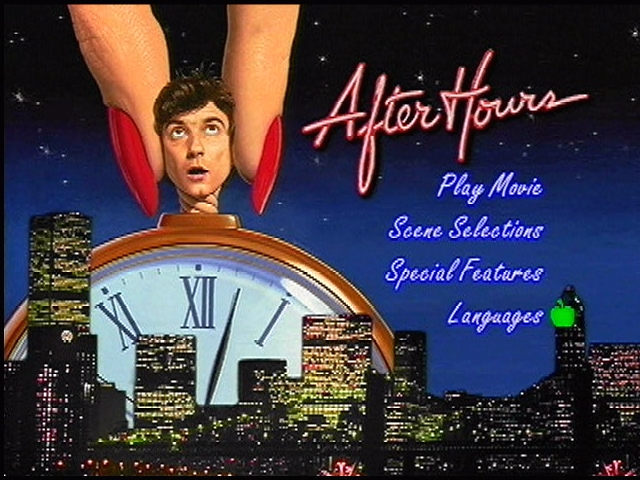
For a 19 year-old movie “After Hours’” Widescreen Anamorphic (1:85:1) Video Transfer looks very sharp and clean except for minor dirt specs here and there. Skin tones are excellent and Michael Ballhaus’ nighttime cinematography brings little details about the Soho locations (smoke, neon lights, gigantic lofts, wet pavement, etc.) to the attention of Scorsese’s perpetually roving camera. The English & French Dolby Digital 2.0 Stereo Soundtracks are clear and audible (particularly the dialogue) but not outstanding. Howard Shore’s electronic score is at least minimalist and unobtrusive. English, French and Spanish Subtitles are also included.
Special features include a loaded (but not scene specific) Commentary Track cued together from interviews with Scorsese, Dunne, cinematographer Michael Ballhaus, producer Amy Robinson and editor Thelma Schoonmaker. The commentary skips over scenes that are silent, so the movie ends up lasting about 20 min. less than its running time. The commentary overlaps with information found in the 20 min. ’Filming For Your Life: Making After Hours’ Documentary. The genesis of the story and how it wound up being directed by Scorsese make for interesting background knowledge that makes repeat viewing of “After Hours” an appealing proposition. You could watch the documentary and not have to listen to the commentary track though (or vice-versa).
There are also seven Deleted Scenes (shown consecutively for eight minutes) and the movie’s Theatrical Trailer.
bottom line:
”After Hours” is an ‘artsy,’ convoluted, surreal and claustrophobic movie that’s equal parts urban nightmare, quirky drama and black comedy. It’s Scorsese’s valentine to NYC’s artsy downtown district circa 1985, the same way “Taxi Driver” captures midtown Manhattan in the late 1970’s. A sharp video transfer, decent sound and excellent special features make this cult flick’s DVD debut a good one.
By - J.M. Vargas
 1/2